Wednesday, March 30, 2011

Seagulls - Progress


Last night I began blocking in the background for the drawing I showed yesterday. It's coming along well and I am pleased with the progress so far. First step was to isolate my  scanned drawing in a channel layer and then load it as a selection. I then  colored the drawing a little so that it wasn't all black.  I changed the drawing to a multiply layer, added another layer behind it for background color and started painting. As I progressed with the background I found myself erasing out the drawing from the top layer. Initially thought I would leave a lot of the drawing showing, but I am beginning to change my mind and may just paint over all the line work before I am done. We'll see how it goes.

Tuesday, March 29, 2011

Seagulls and Crickets


I'm just starting a fun little piece for a poem that will run in the Friend magazine. Folks from here in Utah will probably be familiar with the story of how seagulls save the crops of early Mormon pioneers from a massive cricket infestation shortly after their arrival in the Great Salt Lake valley. The account has it that the pioneers battled the crickets in vain until hoards of seagulls arrived from the nearby Great Salt Lake to devour the crickets. Not only did they eat their fill, but they then flew back to the lake to disgorge them, returning to eat more.Certainly this was a miraculous deliverance that preserved the crops of the desperate settlers. Here's the final design sketch. I'll be using Photoshop to render the final artwork.

Friday, March 25, 2011

Toys As Reference Material

Grandpa's Tractor (cropped) Acrylic/mixed media

Gathering the right reference material for your artwork can be a challenge, especially if you don't have easy access to the real thing. There are only so many sources to look to in your search for the right information (Internet, libraries, museums) and sometimes those results are unsatisfactory. I try to look for alternate sources to obtain the pictures that I need for a given project and one of those is using toy versions of the object in question.


 Over the years I have purchased and photographed a number of scale model ships and cars (you have to assemble them first) as well as replica toys as small as Matchbox cars.


For the above project, I found a set of three John Deere tractors to use. I picked the one that I liked the best and then set it up at the angle and lighting condition I wanted for my painting. I always draw out my idea sketches first so the photography goes smoothly and fits into my design.


Using a macro setting, I zoomed in as closely as I could and took the photos I needed. I then made final drawings and painted from my "toy reference". I could never have accurately imagined the angle of the overturned tractor without using this process.

Thursday, March 24, 2011

Notes From Bill Perkins Workshop
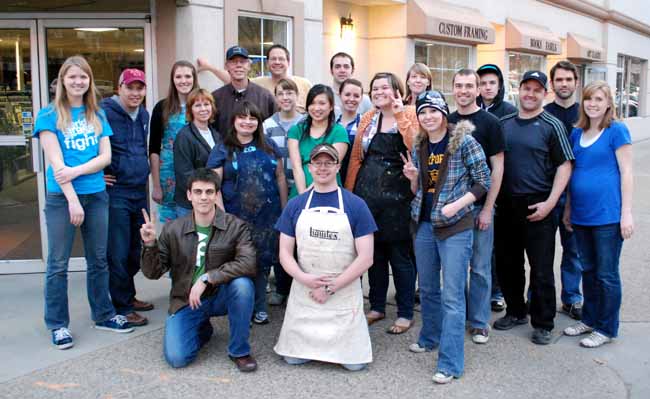
Our workshop group on the final day. I am next to Bill (center back with my arm against the wall)

If you have been reading this blog lately, you have noticed a few entries regarding the Bill Perkins Color workshop that I attended a few weeks back So much was covered that it is impossible to give a full recap here without multiple posts. I will continue to break down the most interesting concepts from the workshop in future posts, but today, I wanted to run down a few tips from Bill that I scribbled down in my sketchbook.

ALWAYS squint to see value, but NEVER squint to see color

The value [of a color] cannot be quantified on a color wheel rather it is based on perception.

Large masses reflect more light than small masses, therefore they appear lighter than small masses, because they indeed are. Consequently, small masses (such as the nose on a face)are darker.

Highlights are the color of the light source

Light areas are the local color plus the color of the light source

When lit, objects of mid value create potential for greater range of contrast than objects of either light or dark value. Mid value has the highest value range.

Some of these concepts I had heard before, and they all rang true, but having them all put together in the context of a workshop was a really valuable experience for me. I hope these tips will help you as well.

 I apologize for not posting as frequently of late, I am in the middle of a really big project which I can't spill about. Someday after it becomes public, I'll share. Thanks for being patient. I will post as much as I can in the interim.

Monday, March 21, 2011

Tip of the Day: Paint Mixing

Bill Perkins Demonstrating at the workshop

As I have mentioned in previous posts, I learned a lot of things during the three days I spent painting with Bill Perkins. One very simple tip that Bill shared with us had to do with mixing just the right tint or shade of paint. Have you ever been mixing up a nice batch of the perfect color? Perfect except it needs just a touch of Thalo green or some other color to make it just right? What happens next always frustrates me. You get just a touch of Thalo on the end of your brush and mix it into your lovingly mixed color pile and WHAM, the whole thing becomes this pea green mess instead of that cool shadow flesh color you intended. You scrape your palette and begin again. Frustration. Well, never again, and I will tell you the solution that Bill gave us. DON'T mix the Thalo (or whatever) right into your batch of paint! First take a little of the tinting color and mix it with your white in a separate pile until it reaches the same value as your desired color and then mix a bit of this new color into your paint. The values are the same, so you won't risk absolutely killing the color you worked to get right in the first place. When Bill said this, I went DUH! It's amazing how you can work for so many years and still learn new techniques and concepts. The more I know, the more realize that I don't know about painting. Keep on learning!

Saturday, March 19, 2011

First Line Contest

It was a dark and stormy night...

The Writing and Illustrating for Young Readers conference is sponsoring a First Line Contest. If you are a writer, aspiring writer, or illustrator who wants to start writing their own books, you may want to enter this contest. The competition is open to all genres in the Young Adult market and there will be prizes.  Entrance rules and requirements are posted here. I attended the writing  for picture books workshop a couple of years ago and it was a very valuable experience. This year's picture book writing workshop will be taught by Kristyn Crow- author of Cool Daddy Rat, Skeleton Cat and Bedtime at the Swamp.There is also a week long workshop for picture book illustrators. This year's guest artist is Kevin Hawkes  illustrator of Library Lion and many others.

Friday, March 18, 2011

Spring Plowing

Spring Plowing - Acrylic, 22" x 11"

The snow is gone and it's time to start thinking about cultivating my garden plot. Seems like more often than not, I get distracted and miss my early window for tilling. This year I hope to have the ground ready for planting by mid May. We usually grow everything from beans and squash and corn, to beets, carrots, potatoes and peppers. I grew a really sweet watermelon a couple of years back and I can already almost taste those late summer tomatoes. I am really looking forward to getting plants in the ground. Nothing like fresh grown veggies in the summer. This picture was from my picture book Spring Song, by Barbara Seuling.